Calm Pets During Vacuuming: Training & Safe Zones

Helping Pets Handle Vacuum Stress: Calm Routines, Training Steps, and Home Setup
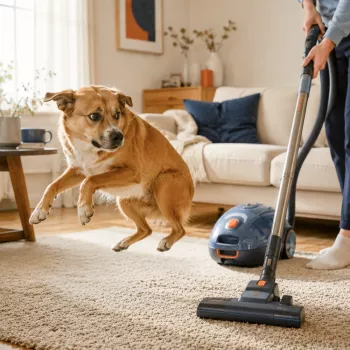
Many pets react to vacuums with fear, barking, hiding, or frantic chasing. Stress often comes from loud noise, sudden movement, unfamiliar smells, and past startling experiences. With a few environmental tweaks and short, structured training sessions, most dogs and cats can learn to stay calm (or at least cope comfortably) during cleaning. For more guidance, see Fearful dogs | Cornell University College of Veterinary Medicine.
Why vacuums feel overwhelming to pets
To people, a vacuum is a predictable appliance. To many pets, it’s a noisy, fast-moving object that appears without warning and invades their space. For further reading, see Adopting an under-socialized dog – Humane Colorado.
- Noise sensitivity: High volume and shifting pitch can be startling, especially for anxious pets.
- Visual and movement triggers: The vacuum “approaches,” changes direction suddenly, and may resemble a threat (or prey).
- Scent and airflow: Dust, odors, and air movement can bother pets with allergies or respiratory sensitivity.
- Learned fear: One scary moment (a bump, a cord snap, debris clattering) can create a lasting association.
- Herding/chasing instincts: Some dogs get over-aroused rather than fearful, leading to chasing, body slamming, or nipping.
Common reactions and what they usually mean
| Reaction | Likely driver | Best first response |
|---|---|---|
| Hiding, trembling, tail tucked | Fear response / noise sensitivity | Create a quiet safe zone and start distance-based training |
| Barking, lunging, snapping at the vacuum | Over-arousal, fear, or guarding | Increase distance, use a leash/gate, reward calm, avoid punishment |
| Chasing the vacuum repeatedly | Predatory/herding pattern or stress displacement | Interrupt with a cue, redirect to a toy/chew, train calm stationing |
| Panting, pacing, drooling | Stress escalation | Pause cleaning, lower intensity, use shorter sessions and calming enrichment |
| Refusing food during vacuuming | High stress (over threshold) | Move farther away, reduce sound exposure, rebuild gradually |
Set up the home for calmer cleaning days
Before any training plan, set the stage so your pet can succeed. Management prevents panic, and preventing panic is progress.
- Designate a safe zone: A quiet room, covered crate, or closet nook with a bed, water, and familiar scent items.
- Use sound buffering: Close doors, place a towel at the door gap, and run a fan or white noise in the safe zone.
- Block sight lines: Baby gates, an exercise pen, or closing curtains can reduce the “it’s coming for me” feeling.
- Pre-load comfort: Offer a long-lasting chew, lick mat, or puzzle feeder a few minutes before vacuuming starts.
- Time it right: Vacuum after a walk or play session, when pets are naturally more ready to rest.
- Avoid chasing: Never follow a frightened pet with the vacuum. Keep movement predictable and give space.
If your pet struggles with loud sounds in general, the American Veterinary Medical Association (AVMA) overview on noise phobias is a helpful starting point for understanding why “just get used to it” often doesn’t work.
Step-by-step training: from “scary object” to background appliance
The goal is not to “win” against the vacuum. The goal is to teach your pet, through repeated calm exposures, that nothing bad happens—and good things often do—when the vacuum appears.
1) Start with the vacuum turned off
Place the vacuum in a room and reward calm behavior at a comfortable distance. Calm can look like sniffing, soft eyes, loose posture, or choosing to disengage.
2) Build positive association
Toss high-value treats near (not right next to) the vacuum. End sessions while your pet is still relaxed, so the “vacuum time” story ends well.
3) Add movement without noise
Roll the vacuum a few inches, reward, then stop. Gradually increase movement only if your pet stays loose and curious rather than tense or frantic.
4) Introduce sound at very low intensity
If possible, briefly turn it on in another room or far away. Reward immediately, then turn it off. Over time, you can decrease distance and increase duration.
5) Teach a “station” behavior
A mat settle, “place,” or relaxed crate time gives your pet a clear job: go to the spot, earn rewards, and let the vacuum fade into the background.
6) Watch thresholds and keep sessions short
For more detail on fear and phobias (including why gradual exposure matters), the ASPCA’s guide to fear and phobias is a solid reference.
During vacuuming: practical routines that prevent setbacks
Extra calming supports (and when to ask a professional)
A ready-made approach to reduce vacuum stress
Consistency is the hard part—especially in busy households. For those who want a guided plan with clear practice steps, Helping Pets Handle Vacuum Stress focuses on building calmer associations, structured exposure, and day-to-day management so cleaning becomes less disruptive.
Pair any program with the core principles that make the biggest difference: distance, gradual sound exposure, predictable routines, and rewards for calm behavior. If you’re stocking up on practical comforts for cleaning days, a cozy layer like the Nike Men’s Blue Hooded Sweatshirt with Front Pockets can make longer training-and-cleaning sessions easier to stick with.
FAQ
How long does it take for a pet to stop being afraid of the vacuum?
Many pets improve in days to a few weeks with consistent, short sessions, but severe fear can take longer. Progress depends on staying under threshold and practicing often without pushing too fast.
Should a pet be left in the same room during vacuuming to “get used to it”?
Forced exposure can backfire by making the vacuum feel inescapable. Use safe separation or distance-based training with rewards, and only keep a pet in the same room if they’re already relaxed.
What if a dog tries to attack or bite the vacuum?
Stop vacuuming, create distance, and use a barrier, leash, or gate to prevent rehearsing the behavior. Then work on stationing (“place”), gradual desensitization, and redirection to appropriate outlets; involve a trainer or veterinary behavior professional if safety is a concern.









Leave a comment